


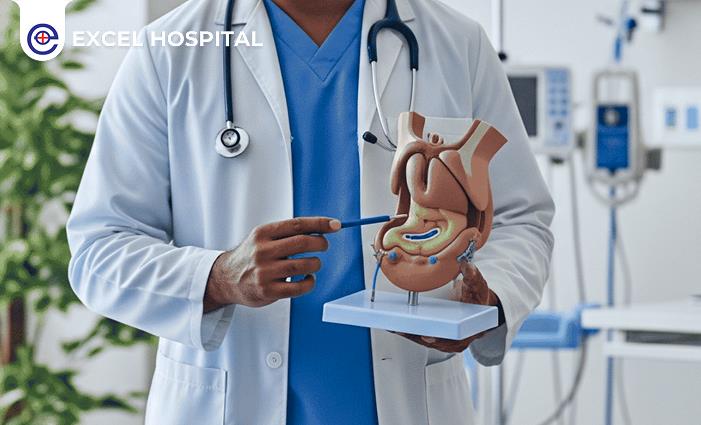

Hernia – Types, Causes & Laparoscopic Treatment: A Complete Guide

What Is a Hernia — And Why Does It Happen?
A hernia occurs when an internal organ or fatty tissue squeezes through a weak spot or gap in the surrounding muscle or connective tissue that normally holds it in place. Think of it like a inner tube pushing through a crack in a tyre — the pressure is always there, and the weak point eventually gives way.
Hernias most commonly occur in the abdominal region — near the belly button, groin, or at the site of a previous surgical incision. They can develop gradually over years, or appear suddenly after a moment of intense physical strain. And while some hernias cause immediate, obvious discomfort, many start as a barely-noticeable bulge that people learn to live with — until they shouldn’t.
The critical thing to understand is this: a hernia will not heal on its own. The muscular defect that allows the hernia to form cannot repair itself without surgical correction. And the longer a hernia goes untreated, the higher the risk of serious complications — including strangulation, which is a medical emergency.
Diagram: How a hernia forms — intestinal tissue pushes through a gap in the weakened abdominal muscle wall, creating a visible bulge
Types of Hernia — Not All Hernias Are the Same
Most people assume hernia means one thing — a lump in the groin. But hernias occur in several locations across the body, each with its own characteristics, risks, and treatment approach. Here’s a clear breakdown of the most common types:
The most common type — accounting for nearly 75% of all hernias. Occurs in the groin area when intestinal tissue pushes through the inguinal canal. Far more common in men due to anatomical differences. Often appears as a bulge in the groin or scrotum that may disappear when lying down.
Occurs at or near the belly button when part of the intestine protrudes through the abdominal wall. Very common in infants — most close on their own by age 2. In adults, it is associated with obesity, pregnancy, and repeated abdominal strain, and requires surgical repair.
Develops at the site of a previous abdominal surgery, where the scar tissue can be weaker than normal muscle. Can appear months or even years after surgery. More common in patients who are obese, smoke, or had wound infections after their previous operation.
A portion of the stomach pushes up through the diaphragm into the chest cavity. Unlike other hernias, it cannot be seen or felt as a bulge. It typically causes acid reflux, heartburn, chest discomfort, and difficulty swallowing. More common in people over 50.
Similar to inguinal but occurs lower in the groin, just below the crease where the leg meets the abdomen. More common in women, especially those who are pregnant or obese. Femoral hernias have a higher risk of strangulation and generally require prompt surgical attention.
Occurs in the upper middle abdomen, between the belly button and breastbone. Often small and may cause minimal symptoms — but fatty tissue can become trapped, causing persistent pain. Surgical repair is straightforward and highly effective.
Diagram: Common locations where different types of hernia appear on the human body
Symptoms of Hernia — What Does It Actually Feel Like?
Hernias don’t always announce themselves dramatically. Some are painless lumps that people discover by accident. Others cause significant discomfort from the start. Here’s what to look out for:
The most tell-tale sign — a soft, noticeable bulge in the abdomen, groin, or near the belly button. It may disappear when lying down and reappear when standing, coughing, or straining.
Pain or discomfort at the site of the hernia — especially when bending over, coughing, or lifting. The pain may be dull and intermittent early on, becoming sharper and more persistent as the hernia grows.
Lifting heavy objects, exercise, or prolonged standing typically increases pressure in the abdomen and worsens hernia-related discomfort. This is one of the earliest functional signs people notice.
Some hernias produce a burning, pulling, or heavy dragging sensation around the bulge — particularly inguinal hernias, which can extend discomfort into the testicle or inner thigh in men.
Specific to hiatal hernias — chronic acid reflux, a burning sensation in the chest, or difficulty swallowing solid food are the primary complaints. These are often mistaken for simple acidity for years.
When a portion of the intestine is trapped in the hernia, it can partially block bowel movement — causing nausea, vomiting, constipation, or inability to pass gas. These symptoms require urgent evaluation.
What Causes a Hernia? Risk Factors You Should Know
Hernias develop when there is a combination of muscle weakness and increased internal pressure. Understanding what weakens the abdominal wall — and what increases the pressure pushing against it — helps you understand both why hernias happen and how to reduce your risk.
Some people are born with naturally weaker areas in the abdominal wall — particularly in the inguinal region. These don’t always cause problems immediately but can develop into hernias over decades, especially with added physical strain.
Persistent coughing — from smoking, asthma, or chronic lung disease — repeatedly increases intra-abdominal pressure. Over time, this sustained force can push tissue through a weak spot in the abdominal wall.
Repeated lifting of heavy weights — especially without proper technique — dramatically raises abdominal pressure. This is one of the most common triggers of inguinal and abdominal hernias in physically active men and manual labourers.
Excess body weight puts constant, elevated pressure on the abdominal wall. Obese individuals have a significantly higher risk of developing umbilical, inguinal, and incisional hernias — and a higher recurrence rate after repair.
The growing uterus stretches and weakens abdominal muscles. Multiple pregnancies, large babies, or prolonged labour can all contribute to umbilical and inguinal hernia formation in women during or after pregnancy.
Regularly straining during bowel movements significantly increases abdominal pressure. This sustained pressure over years is a major risk factor for multiple hernia types — including inguinal, umbilical, and rectal prolapse.
Any abdominal incision creates scar tissue that is inherently weaker than native muscle. Incisional hernias develop in approximately 10–15% of patients who undergo open abdominal surgery — particularly if healing was complicated.
Muscle tissue naturally weakens with age. The older you get, the more likely the abdominal wall is to develop weak spots — especially under the ongoing pressure of daily activities, coughing, or straining.
Hernia Treatment — Surgery Is the Only Permanent Solution
Let’s be straightforward about this: no medication, truss (support belt), exercise programme, or home remedy can fix a hernia. They may temporarily ease discomfort, but they cannot close the muscular defect. Surgery is the only definitive treatment. The real question is when and which type.
Laparoscopic Hernia Repair — The Gold Standard at Excel Hospital


Laparoscopic (keyhole) hernia surgery is now the preferred approach for the vast majority of hernia repairs — and for good reason. Instead of a large incision, the surgeon makes 3 tiny cuts (each 5–10mm), inserts a camera and specialised instruments, and repairs the hernia from the inside using a surgical mesh to reinforce the weak area.
At Excel Hospital, our Laparoscopic Surgery team specialises in both TEP (Total Extraperitoneal) and TAPP (Transabdominal Preperitoneal) laparoscopic hernia repairs — two of the most advanced techniques available, chosen based on the hernia type, size, and patient profile.
Laparoscopic vs Open Surgery — A Clear Comparison
| Factor | Open Surgery | Laparoscopic Surgery |
|---|---|---|
| Incision Size | 5–10 cm single large incision | 3 tiny cuts (5–10 mm each) |
| Pain After Surgery | Moderate to significant | Minimal — managed with oral medication |
| Hospital Stay | 2–4 days | 1 day (sometimes same-day discharge) |
| Return to Normal Activity | 4–6 weeks | 1–2 weeks for most patients |
| Visible Scar | Noticeable scar at incision site | Barely visible tiny marks |
| Risk of Recurrence | Higher (especially for inguinal hernias) | Lower with mesh reinforcement |
| Bilateral Hernia Repair | Requires two separate incisions | Both sides repaired through same 3 ports |
What to Expect — The Laparoscopic Hernia Repair Process
Your surgeon will assess the hernia type, size, reducibility, and your overall health. Blood tests, ECG, and an ultrasound or CT scan may be ordered to plan the most appropriate repair technique for your specific case.
Laparoscopic hernia repair is performed under general anaesthesia. You’ll be asked to fast from the previous night. The procedure typically takes 45–90 minutes depending on hernia type and complexity.
The surgeon reduces the herniated tissue back into the abdomen and places a surgical mesh over the defect to reinforce the weak area. The mesh becomes integrated into the surrounding tissue over weeks, providing lasting structural support.
Most patients are walking within hours of surgery. Discharge is typically on the same day or the following morning. Pain is mild and controlled with basic oral medication. Light activity resumes in 3–5 days; full activity in 1–2 weeks.
A follow-up visit at 1–2 weeks checks wound healing and recovery progress. Laparoscopic repair with mesh has a recurrence rate of less than 2% — making it a highly durable, long-term solution.
🔗 Related Services at Excel Hospital Ahmedabad
Common Hernia Myths — Cleared Up Once and for All
There’s a lot of outdated advice floating around about hernias — from relatives, online forums, and even some well-meaning but misinformed sources. Here are the most common myths and the truth behind them:
| ❌ Myth | ✅ Fact |
|---|---|
| A hernia will heal on its own with rest | Hernias never heal on their own. The muscular defect cannot repair itself. Surgery is the only solution |
| If it doesn’t hurt much, it doesn’t need surgery | Painless hernias still carry the risk of strangulation — a life-threatening emergency. Size and pain are not reliable indicators of urgency |
| A support belt or truss can fix a hernia | Belts only provide temporary comfort — they do not repair the defect. Prolonged use can actually make the hernia harder to repair later |
| Hernia surgery has a long, painful recovery | Laparoscopic hernia repair has minimal pain and most patients return to normal activities within 1–2 weeks |
| Only men get hernias | While inguinal hernias are more common in men, women commonly develop femoral, umbilical, and incisional hernias |
| Once repaired, a hernia won’t come back | Recurrence is possible — particularly with open repair or if underlying risk factors (obesity, smoking) are not addressed. Laparoscopic mesh repair has a recurrence rate of under 2% |
Most patients recover fully within 2–4 weeks after laparoscopic hernia repair — significantly faster than open surgery
When Should You See a Surgeon? Here’s a Simple Guide
| Your Situation | What to Do |
|---|---|
| You notice a soft, reducible lump with mild discomfort | 🟡 Book a consultation within 1–2 weeks |
| Lump is growing in size or causing increasing pain | 🟠 See a surgeon this week — don’t delay |
| Hernia cannot be pushed back and is hard or tender | 🔴 Go to hospital today — urgent evaluation |
| Sudden severe pain with nausea and vomiting | 🔴 Emergency — possible strangulation, act immediately |
| Known hernia, planning pregnancy or heavy activity | 🟡 Get surgical advice before — repair first is safer |
| Post-surgery bulge near old abdominal scar | 🟠 Get evaluated — could be incisional hernia |
| Chronic heartburn + difficulty swallowing (possible hiatal) | 🟡 Consult a gastro specialist for evaluation |
Dr. Joy Abraham has extensive experience in advanced laparoscopic hernia repair — including inguinal, umbilical, incisional, and complex recurrent hernias. His approach combines precise surgical technique with a genuinely patient-centred philosophy: every patient receives a clear explanation of their diagnosis, the available options, and an honest recommendation — with no unnecessary procedures or rushed decisions. Hundreds of patients across Ahmedabad have experienced faster recovery, minimal pain, and long-lasting results under his care. Learn more about Dr. Joy Abraham →
That Bulge Isn’t Going to Go Away on Its Own. Let’s Fix It.
Whether you’ve just noticed a hernia or have been ignoring one for a while — now is the right time to get a proper evaluation. Book your consultation at Excel Hospital, Ahmedabad today and find out exactly where you stand.
📅 Book Your Consultation Now
📞 +91-84691 59595 | +91-79489 49595
📧 [email protected]
📍 206, Shivalik 2, Satellite, Ahmedabad — 132 Feet Ring Road
Frequently Asked Questions About Hernia
Medical Disclaimer: This article is for general health awareness and educational purposes only. It is not a substitute for professional medical advice, diagnosis, or treatment. Please consult a qualified GI surgeon for any personal health concerns related to hernia. | © 2025 Excel Hospital, Ahmedabad. All Rights Reserved. | www.excelhospitals.com