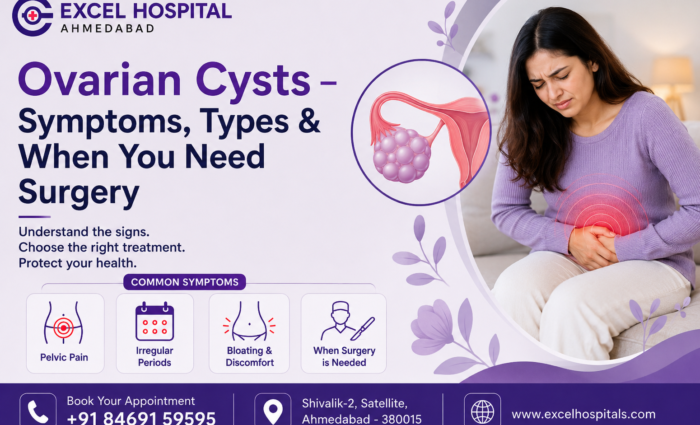

Ovarian Cysts – Symptoms, Types & When You Need Surgery: A Complete Guide for Women in Ahmedabad
What Are Ovarian Cysts — And How Common Are They in Women?
An ovarian cyst is a fluid-filled sac that develops on or inside one of the ovaries. They are extraordinarily common — most women will develop at least one ovarian cyst during their reproductive years, and the vast majority of these are entirely benign (non-cancerous), cause no symptoms, and resolve on their own within a few menstrual cycles.
However, not all cysts are the same. The type, size, growth behaviour, and specific characteristics of a cyst determine whether it is something to simply monitor, actively treat, or surgically remove. This distinction — which only a specialist with ultrasound expertise can make — is why getting a proper evaluation in Ahmedabad is so important, rather than relying on a single brief scan result with no follow-up.
According to the National Institutes of Health (NIH), functional ovarian cysts occur in nearly all premenopausal women at some point. The real concern arises when cysts are persistent, growing, structurally complex, or occur in postmenopausal women.
Types of Ovarian Cysts — Understanding What You Have
The single most important piece of information about your cyst is its type — because different types have very different implications for your health, fertility, and need for treatment.
Types of ovarian cysts vary significantly in their composition, risk, and treatment approach — from benign functional cysts that resolve naturally to endometriomas and dermoid cysts that typically need surgical removal
Most common. Form when a follicle doesn’t release its egg and continues to grow. Rarely causes symptoms. Almost always resolves within 1–3 menstrual cycles without treatment.
Form after ovulation when the corpus luteum (post-ovulation structure) fills with fluid. Can cause pelvic pain if it bleeds internally. Usually resolves but occasionally requires surgery if it ruptures.
Contains old dark menstrual blood — caused by endometriosis on the ovary. Significantly impacts egg quality and fertility. Surgical removal by laparoscopy is typically recommended for cysts over 4 cm.
Contains hair, fat, skin, and sometimes teeth — formed from embryonic cells. Always require surgical removal. Benign in most cases but grow over time and carry a risk of torsion (twisting).
Develop from ovarian surface cells. Can become very large (10–30 cm). Serous cystadenomas contain watery fluid; mucinous contain thick fluid. Surgical removal is typically recommended.
Multiple small follicles (not true cysts) that form due to hormonal imbalance in PCOS. These are not the same as ovarian cysts — they are treated entirely differently through hormonal management and lifestyle.
Symptoms of Ovarian Cysts — When to Be Concerned
The majority of ovarian cysts cause no symptoms whatsoever — they are discovered incidentally during a routine ultrasound done for an unrelated reason. When symptoms do occur, they depend on the cyst’s size, type, and whether complications (rupture, torsion) have developed.
A dull, aching pain or feeling of heaviness in the lower abdomen — particularly on the side where the cyst is located. May be constant or intermittent, and often worsens around periods or during physical activity.
A persistent sensation of bloating or fullness in the lower abdomen — particularly with larger cysts. Some women notice visible abdominal swelling as a cyst grows.
Large cysts pressing on the bladder cause the need to urinate more frequently. Some women feel they cannot fully empty their bladder — often mistaken for a urinary tract infection.
Particularly associated with ovarian torsion (a twisted cyst) or a ruptured cyst — both of which can also cause sudden, severe pain. Nausea alongside acute pelvic pain is always an emergency.
Some cysts — particularly endometriomas and PCOS-related — disrupt hormonal balance and cause irregular, missed, or unusually heavy periods.
Deep pelvic pain during sex — particularly with larger cysts or endometriomas. This is frequently under-reported and frequently misattributed to “dryness” or “relationship issues” rather than a physical cause.
Diagnosis — What Investigations Are Done for Ovarian Cysts in Ahmedabad
| Investigation | What It Shows | When Used |
|---|---|---|
| Transvaginal Ultrasound (TVS) | Size, location, type (simple/complex), wall thickness, solid components, Doppler blood flow | First-line — every case |
| Transabdominal Ultrasound | Large cysts, abdominal extent | When TVS is not possible or cyst is very large |
| MRI Pelvis | Detailed tissue characterisation — distinguishes endometrioma, dermoid, complex cysts | Uncertain ultrasound findings; surgical planning |
| CA-125 Blood Test | Elevated in ovarian cancer, endometriosis, and some benign conditions | Complex cysts in postmenopausal women; borderline cases |
| AMH & Hormone Panel | Ovarian reserve, hormonal status | Fertility assessment; PCOS evaluation |
| Full Blood Count | Anaemia, infection markers | If ruptured cyst or torsion is suspected |
🏥 Ovarian Cyst Evaluation in Ahmedabad — Excel Hospital
At Excel Hospital, Satellite, Ahmedabad, Dr. Aarti Vazirani provides comprehensive ovarian cyst evaluation including high-resolution transvaginal ultrasound, CA-125 if indicated, MRI referral, and a clear management plan. Women across Ahmedabad — from Vastrapur, Gota, Chandkheda, Maninagar, and Nikol — visit Excel Hospital for specialist gynaecological assessment.
Ovarian Cyst Treatment in Ahmedabad — When to Watch, When to Operate
The most important decision in ovarian cyst management is not whether to operate — it is first to correctly characterise the cyst. Here is a clear, evidence-based framework used at Excel Hospital:
| Cyst Characteristics | Recommended Approach | Typical Follow-up |
|---|---|---|
| Simple cyst <5 cm, premenopausal, no symptoms | Watchful waiting — repeat ultrasound in 6–12 weeks | Most resolve spontaneously |
| Functional cyst <8 cm, resolving | Monitor with serial ultrasound | Repeat scan in 4–6 weeks |
| Endometrioma >4 cm with fertility concern | Laparoscopic cystectomy — ovary-sparing | Pre-conception fertility assessment |
| Dermoid cyst >5 cm | Laparoscopic dermoid cystectomy | Surgery recommended — growth and torsion risk |
| Complex cyst with solid areas or vascularity | Urgent specialist evaluation + MRI ± CA-125 | Surgical opinion within 2–4 weeks |
| Any cyst in postmenopausal woman | Urgent specialist evaluation — even small simple cysts | Multidisciplinary assessment |
| Torsion / ruptured cyst with haemorrhage | Emergency laparoscopy | Same-day surgical intervention |
Laparoscopic Cyst Removal in Ahmedabad — What to Expect
When surgery is recommended, laparoscopic (keyhole) ovarian cystectomy is the gold standard approach at Excel Hospital’s Minimally Invasive Gynaecological Surgery Clinic in Ahmedabad. Here’s what the procedure involves:
- 3 small incisions (5–10mm each) — no large cut
- Camera + instruments inserted to remove the cyst while preserving the healthy ovarian tissue
- Cyst sent for histology — laboratory examination to confirm the tissue type
- Hospital stay: typically 1 day, sometimes same-day discharge
- Recovery: light activities in 3–5 days; full activity in 1–2 weeks
- Fertility preservation: in most cases, the ovary is fully preserved and ovarian function maintained
For emergency torsion, the procedure also involves untwisting the ovary and assessing its viability — saving the ovary in most cases when treatment is prompt. This underscores the importance of not delaying care when sudden severe pelvic pain occurs.
Ovarian Cysts & Fertility — Key Facts for Women in Ahmedabad
The impact of an ovarian cyst on fertility depends entirely on its type:
| Cyst Type | Fertility Impact | Recommended Approach Before Trying to Conceive |
|---|---|---|
| Functional cysts | None — usually resolve before conception matters | Monitor; conceive naturally once resolved |
| Endometrioma | Significant — damages egg reserve, affects implantation | Specialist pre-conception evaluation; consider surgery before IVF |
| Dermoid cyst | Moderate — mainly torsion risk during pregnancy | Surgical removal recommended before planned conception |
| Cystadenoma (large) | Physical compression of ovary | Surgical removal before conception if large |
| Polycystic ovaries (PCOS) | Anovulation — main cause | Ovulation induction; lifestyle management |
For women in Ahmedabad planning pregnancy with an ovarian cyst, a pre-conception evaluation at Excel Hospital’s Infertility Treatment Clinic ensures that any cysts affecting fertility are appropriately managed before attempting conception — optimising the chances of a healthy pregnancy.
🔗 Related Services at Excel Hospital, Satellite, Ahmedabad
Ovarian Cyst Myths — Cleared Up for Women in Ahmedabad
| ❌ Myth | ✅ Fact (2026) |
|---|---|
| All ovarian cysts are dangerous and need surgery | 95% of ovarian cysts in premenopausal women are benign. Most functional cysts resolve on their own within 1–3 cycles without any treatment |
| An ovarian cyst means I have PCOS | PCOS involves multiple small follicles due to a hormonal disorder — very different from a true ovarian cyst. A single cyst on one ovary is not PCOS |
| Ovarian cysts always cause symptoms | The majority of ovarian cysts cause no symptoms — they are discovered incidentally on ultrasound. Their presence does not always mean something is wrong |
| A raised CA-125 means I have ovarian cancer | CA-125 is elevated by many benign conditions including endometriosis, fibroids, infections, and menstruation itself. It must be interpreted alongside ultrasound findings by a specialist |
| Ovarian cysts make getting pregnant impossible | Functional cysts have no impact on fertility. Endometriomas and large cysts may need treatment before IVF but do not make pregnancy impossible |
| Surgery will remove your ovary completely | Laparoscopic cystectomy removes only the cyst — preserving the ovary and its egg-producing function in the vast majority of cases |
When to See a Gynaecologist in Ahmedabad for an Ovarian Cyst
| Your Situation | What to Do |
|---|---|
| Just told you have a cyst on ultrasound — no further info given | 🟡 Book a gynaecology consultation for proper characterisation and plan |
| Known cyst, trying to conceive without success | 🟠 Pre-conception evaluation at infertility clinic this week |
| Sudden severe one-sided pelvic pain with nausea | 🔴 Emergency — go to hospital immediately (possible torsion) |
| Cyst growing on repeat ultrasound | 🟠 Surgical opinion within 2 weeks |
| Postmenopausal with any ovarian cyst on scan | 🔴 Urgent specialist evaluation — all cysts after menopause need assessment |
| Pain during sex that you attribute to your cyst | 🟡 Gynaecology consultation — this may indicate endometrioma |
Dr. Aarti Vazirani has extensive experience in evaluating and managing all types of ovarian cysts — from simple monitoring plans for functional cysts to complex laparoscopic surgery for endometriomas and dermoid cysts. Her approach is always evidence-based and fertility-conscious: whenever possible, cyst removal is performed laparoscopically with full preservation of the healthy ovarian tissue. Patients from across Ahmedabad trust her for clear, honest guidance at every step. Learn more about Dr. Aarti Vazirani →
You Deserve More Than “Just Wait and See” — Get Clear Answers in Ahmedabad
If you have been told you have an ovarian cyst and are unsure what to do next — book a specialist consultation at Excel Hospital, Satellite, Ahmedabad. Get the right diagnosis, a personalised plan, and complete clarity about your next steps.
📅 Book Your Consultation in AhmedabadFrequently Asked Questions About Ovarian Cysts in Ahmedabad
Medical Disclaimer: This article is for general health awareness only. It does not constitute medical advice or diagnosis. Please consult a qualified gynaecologist for personal health concerns. Information accurate as of March 2026. | © 2026 Excel Hospital, Ahmedabad. | www.excelhospitals.com