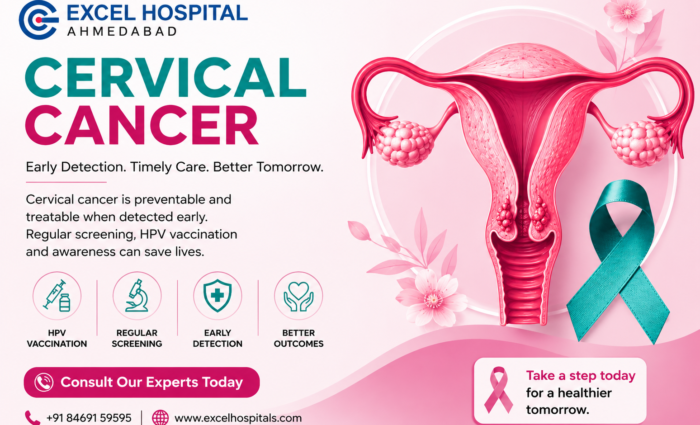

Cervical Cancer – Early Signs, HPV & Prevention Guide: Everything Indian Women Must Know

What Is Cervical Cancer — And Why Is It Still So Common in India?
Cervical cancer is a cancer that starts in the cells of the cervix — the lower, narrow end of the uterus that connects to the vagina. Like most cancers, it doesn’t appear overnight. It typically develops over many years, beginning with pre-cancerous changes in the cervical cells that, if left undetected, gradually progress into invasive cancer.
What makes cervical cancer uniquely significant is that it is almost entirely preventable. Unlike most cancers, we know its primary cause — the Human Papillomavirus (HPV) — and we have both a vaccine to prevent infection and a screening test to catch pre-cancerous changes before they become cancer. This means that with the right awareness and action, this disease should be rare.
And yet, according to the World Health Organization (WHO), India accounts for nearly one-fifth of the world’s cervical cancer deaths — largely because most women are diagnosed at an advanced, harder-to-treat stage. The gap between what is medically possible and what is actually happening comes down to awareness, access, and action.
The cervix connects the uterus to the vagina — cervical cancer begins in the cells at this junction, often with pre-cancerous changes that develop slowly over years
What Is HPV — And What Does It Have to Do With Cervical Cancer?
HPV — Human Papillomavirus — is the single most important factor in cervical cancer. Nearly 99% of all cervical cancers are caused by persistent infection with high-risk strains of HPV. This is not a controversial or debated point — it is one of the most well-established facts in cancer medicine.
HPV is a very common virus. It is transmitted through skin-to-skin contact, including sexual contact — and most sexually active people will encounter HPV at some point in their lives. In the majority of cases, the immune system clears the virus naturally within 1–2 years, with no lasting harm. But in some women, certain high-risk strains of HPV persist — and it is this persistent infection that, over years, can cause cervical cells to become abnormal and eventually cancerous.
HPV infection to invasive cancer takes 10–15 years — giving a large window for prevention through vaccination and Pap smear screening
High-Risk HPV Strains — What You Need to Know
There are over 200 types of HPV, but not all of them cause cancer. HPV types 16 and 18 are responsible for approximately 70% of all cervical cancers — making them the primary targets of the HPV vaccine. Other high-risk strains include HPV 31, 33, 45, 52, and 58. The current vaccines available in India protect against HPV 16 and 18, with some versions also covering additional strains.
Early Signs & Symptoms of Cervical Cancer — Don’t Dismiss These
Here is the uncomfortable truth about early cervical cancer: most early-stage cases have no symptoms at all. This is precisely why screening is so critical — because the disease is often silent until it has advanced to a harder-to-treat stage.
However, as the cancer grows, certain warning signs do begin to appear. If you experience any of the following — especially if they persist or worsen — see a gynaecologist promptly. Do not wait for these to become severe:
Bleeding between periods, after sexual intercourse, or after menopause. This is the most common and important warning sign of cervical cancer — and should never be dismissed as “irregular periods.”
A watery, pink, bloody, or foul-smelling discharge that is different from your normal discharge. This often appears before bleeding becomes obvious, and is frequently ignored or attributed to infection.
Pain in the lower abdomen or pelvis that is not related to your menstrual cycle — especially a persistent or worsening dull ache — can indicate cervical cancer that has begun to grow beyond the cervix.
Discomfort or pain during sex (dyspareunia) — particularly deep pain — can be an early sign that cervical tissue is affected. This is often the first symptom women notice, yet many feel embarrassed to mention it to a doctor.
In more advanced cases, when the cancer spreads to nearby lymph nodes or nerves, it can cause pain or swelling in one or both legs. This typically indicates the disease has progressed significantly.
Significant, unexplained tiredness and weight loss without trying are general warning signs of cancer. In the context of other symptoms above, they increase the urgency of seeking evaluation.
Who Is at Higher Risk of Cervical Cancer?
While any woman with a cervix can develop cervical cancer, certain factors significantly increase the risk. Knowing your risk profile helps you make smarter decisions about screening frequency and vaccination.
The primary and most significant risk factor. Persistent infection with HPV 16 or HPV 18 accounts for approximately 70% of all cervical cancer cases globally.
Women who have never had a Pap smear — or who have irregular screening — are at dramatically higher risk of late-stage diagnosis. Screening is the single most effective preventive measure.
Tobacco use damages the cells of the cervix and impairs the immune system’s ability to clear HPV infection. Women who smoke are approximately twice as likely to develop cervical cancer as non-smokers.
Women with HIV, those on immunosuppressive medications (organ transplant recipients), or with other immune-compromising conditions are at higher risk because their bodies cannot effectively fight HPV.
Using the pill for 5 or more years is associated with a modestly increased risk of cervical cancer — though this risk falls back to baseline within years of stopping. Regular screening mitigates this risk.
Women who have had 3 or more full-term pregnancies have an increased risk of cervical cancer. The hormonal and physical changes of pregnancy may make the cervix more susceptible to HPV-related changes.
Having a mother or sister with cervical cancer increases your own risk by 2–3 times. This may reflect shared HPV exposure patterns, genetic immune response differences, or other heritable factors.
The cervix is more vulnerable to HPV infection during adolescence, when the cells at the transformation zone are more active. Early sexual debut increases the duration of potential HPV exposure.
Stages of Cervical Cancer — Why Early Detection Changes Everything
Cervical cancer is staged from 0 (pre-cancerous) to 4 (advanced). The stage at diagnosis is the single most important factor determining treatment options and outcomes. Here is what each stage means:
Abnormal cells only on cervix surface. 100% curable. Detected on Pap smear.
Cancer confined to cervix only. 5-year survival: 80–93%. Excellent outcomes with surgery.
Spread beyond cervix but not pelvic wall. 5-year survival: 58–63%. Chemoradiation.
Spread to pelvic wall or lower vagina. 5-year survival: 32–35%. More intensive treatment.
Spread to bladder, rectum, or other organs. 5-year survival: 15–16%. Palliative focus.
Prevention — The HPV Vaccine and Pap Smear: Your Two Most Powerful Tools
The HPV Vaccine — What It Is and Who Should Get It


The HPV vaccine is one of the most significant advances in cancer prevention in recent decades. It works by training the immune system to recognise and fight off HPV infection before it can establish itself in the body. When given before first HPV exposure — ideally before sexual debut — it is highly effective at preventing the strains of HPV most responsible for cervical cancer.
| Vaccine Available in India | HPV Strains Covered | Recommended Age | Doses |
|---|---|---|---|
| Gardasil 4 (Merck) | HPV 6, 11, 16, 18 | 9–26 years (optimal: 9–14) | 2 doses (under 15) / 3 doses (15+) |
| Gardasil 9 (Merck) | HPV 6, 11, 16, 18, 31, 33, 45, 52, 58 | 9–45 years | 2 or 3 doses depending on age |
| Cervarix (GSK) | HPV 16, 18 | 9–25 years | 2 or 3 doses depending on age |
| Cervavac (India — Serum Institute) | HPV 16, 18 | 9–26 years | 2 doses (under 15) / 3 doses (15+) |
Pap Smear Screening — The Life-Saving Test Most Women Delay
A Pap smear (also called a Pap test or cervical smear) is a simple, quick procedure done during a pelvic examination. The doctor gently collects cells from the surface of the cervix and sends them for laboratory analysis. These cells are examined for pre-cancerous changes (CIN) or cancer.
A Pap smear does not diagnose cancer — it identifies abnormal cells before they become cancer. This is exactly why it is so powerful: it gives you a years-long window to intervene with a simple treatment, before the problem escalates.
Cervical cancer screening schedule — frequency depends on age, HPV status, and individual risk factors. Consult your gynaecologist for a personalised plan
🔗 Women’s Care Services at Excel Hospital Ahmedabad
Cervical Cancer Myths — Cleared Up for Good
Few diseases carry more misinformation than cervical cancer. Here are the most harmful myths — and the truth that every woman deserves to know:
| ❌ Myth | ✅ Fact |
|---|---|
| Cervical cancer only affects older women | Peak incidence is between ages 35–44. Young women can and do develop it — particularly if HPV infection is persistent |
| If I have no symptoms, I’m fine | Early cervical cancer is almost always asymptomatic. The only way to detect pre-cancerous changes is through a Pap smear — not by waiting for symptoms |
| The HPV vaccine means I don’t need Pap smears | The vaccine does not protect against all HPV strains. Regular Pap smear screening remains essential even for vaccinated women |
| HPV only affects promiscuous women | HPV is one of the most common viral infections worldwide — any sexually active person can contract it, regardless of the number of partners |
| A Pap smear will show if I have cancer right now | A Pap smear detects abnormal cells that may develop into cancer — not cancer itself in most cases. It is a preventive test, not just a diagnostic one |
| Cervical cancer is always fatal | When detected in Stage 0 or Stage I, cervical cancer has a survival rate above 90%. It is one of the most successfully treated cancers when found early |
Treatment Options for Cervical Cancer
Treatment depends entirely on the stage at which cervical cancer is diagnosed. This is yet another reason why early detection is so critical — the treatment options at Stage 0 and Stage I are far less invasive, less disruptive, and more effective than at advanced stages.
| Stage | Common Treatment Approach | Outcome |
|---|---|---|
| Stage 0 (CIN) | LEEP, cryotherapy, or cone biopsy — outpatient procedures | Nearly 100% cure rate |
| Stage I | Radical hysterectomy or radiation therapy, often combined | 80–93% 5-year survival |
| Stage II | Concurrent chemotherapy + radiation (chemoradiation) | 58–63% 5-year survival |
| Stage III | Chemoradiation ± targeted therapy | 32–35% 5-year survival |
| Stage IV | Systemic chemotherapy, immunotherapy, palliative care | 15–16% 5-year survival |
Dr. Aarti Vazirani is passionate about preventive women’s health — particularly ensuring that women in Ahmedabad have access to timely cervical cancer screening and HPV vaccination. Her clinic offers complete gynaecological care, including Pap smear screening, HPV testing, colposcopy for abnormal results, and management of pre-cancerous cervical changes through minimally invasive procedures. She believes every woman deserves clear, honest information — and a doctor who truly takes the time to explain it. Learn more about Dr. Aarti Vazirani →
When Should You See a Gynaecologist? A Simple Guide
| Your Situation | What to Do |
|---|---|
| Bleeding after sex or between periods | 🔴 See a gynaecologist this week — do not wait |
| Any vaginal bleeding after menopause | 🔴 Urgent evaluation needed — book immediately |
| Watery or foul-smelling unusual discharge | 🟠 Book a consultation within 1–2 weeks |
| Pelvic pain not related to your cycle | 🟠 Get evaluated — do not self-medicate |
| You are 21+ and have never had a Pap smear | 🟡 Schedule a screening now — overdue |
| You are 9–26 and not yet vaccinated for HPV | 🟡 Consult your doctor about HPV vaccination today |
| Your last Pap smear was more than 3 years ago | 🟡 Time to schedule your next one |
Don’t Let Cervical Cancer Catch You by Surprise
Book your Pap smear, HPV test, or gynaecological consultation at Excel Hospital, Ahmedabad today. Early action is the most powerful choice you can make for your long-term health.
📅 Book Your Screening Now
📞 +91-84691 59595 | +91-79489 49595
📧 contact.excelhospital@gmail.com
📍 206, Shivalik 2, Satellite, Ahmedabad — 132 Feet Ring Road
Frequently Asked Questions About Cervical Cancer
Medical Disclaimer: This article is for general health awareness and educational purposes only. It is not a substitute for professional medical advice, diagnosis, or treatment. Please consult a qualified gynaecologist for any personal health concerns related to cervical cancer, HPV, or gynaecological screening. | © 2025 Excel Hospital, Ahmedabad. All Rights Reserved. | www.excelhospitals.com