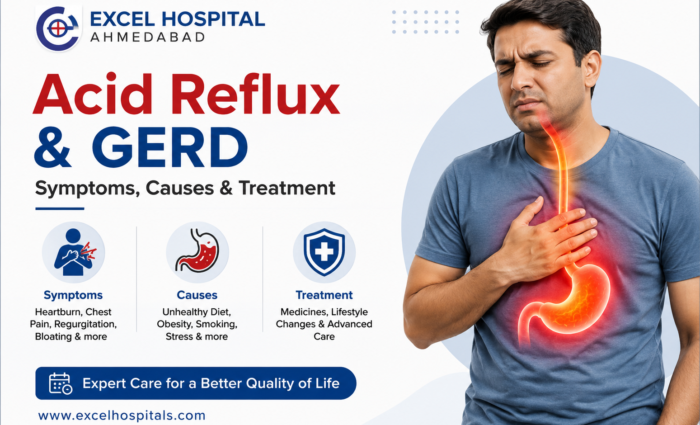

Acid Reflux & GERD – Why Ignoring It Can Be Dangerous: A Complete Guide

What Is GERD — And How Is It Different from Normal Acidity?
Almost everyone experiences heartburn occasionally — a burning sensation in the chest after a heavy meal, spicy food, or lying down too soon after eating. That’s normal. But when acid reflux happens regularly — more than twice a week, consistently — it becomes a medical condition called GERD: Gastroesophageal Reflux Disease.
Here’s what’s actually happening: between your food pipe (oesophagus) and your stomach sits a ring of muscle called the Lower Oesophageal Sphincter (LOS). In healthy digestion, this valve opens to let food into the stomach and then closes tightly. In GERD, this valve is weakened or relaxed — allowing stomach acid to flow back up into the oesophagus. That backwash of acid is what causes the burning sensation.
The problem is not the occasional episode — it’s the repeated exposure. Every time acid enters the oesophagus, it damages the delicate lining. Over months and years, this repeated injury causes inflammation, scarring, and in some cases, pre-cancerous changes. According to the World Health Organization (WHO), oesophageal cancer — which GERD can contribute to — is among the most lethal cancers globally, largely because it is diagnosed late.
In GERD, the Lower Oesophageal Sphincter (LOS) weakens — allowing stomach acid to flow back into the food pipe, causing damage with every episode
Symptoms of GERD — Beyond Just Heartburn
Most people associate GERD only with heartburn. But the condition can present in surprising and often misleading ways — which is why so many cases go undiagnosed or are misattributed to other conditions for years:
A burning sensation in the chest or upper abdomen — typically after meals, when bending over, or lying down. The hallmark symptom of GERD, but its absence doesn’t rule it out.
A sour or bitter-tasting fluid rising into the throat or mouth. Many people experience this at night and mistake it for nausea. It is a direct sign of acid backflow.
Feeling like food is sticking or getting stuck in the chest while eating. This indicates the oesophagus has become narrowed (stricture) due to repeated acid damage — a serious complication.
Acid reaching the throat irritates the vocal cords and airways. Many GERD patients are diagnosed with “asthma” or “chronic cough” for years before the real cause is identified.
GERD-related chest pain can be intense enough to mimic a heart attack — which is why all unexplained chest pain must be medically evaluated. GERD pain is typically burning and related to meals or posture.
Acid reflux worsens when lying flat. Many GERD sufferers wake at night with burning, coughing, or the sensation of choking — significantly impacting sleep quality and daytime function.
Chronic GERD affects gastric motility — the speed at which the stomach empties. This leads to a persistent feeling of fullness, nausea, and bloating even after small meals.
Stomach acid reaching the mouth repeatedly erodes tooth enamel and causes persistent bad breath (halitosis). Dentists often identify GERD before gastroenterologists do.
What Causes GERD? Understanding the Root Problem
GERD is not simply caused by “eating spicy food.” It’s a structural and functional problem — primarily involving a weakened lower oesophageal sphincter — often made significantly worse by lifestyle and dietary factors. Here’s what drives it:
When part of the stomach pushes up through the diaphragm into the chest, it weakens the LOS mechanism. Hiatal hernia is one of the most common anatomical causes of GERD — and often goes undiagnosed for years.
Extra abdominal fat increases pressure on the stomach, forcing acid upward. Obesity is one of the strongest modifiable risk factors for GERD — and weight loss is one of the most effective non-surgical treatments.
Spicy food, citrus fruits, tomatoes, chocolate, mint, fatty foods, coffee, and alcohol all relax or irritate the LOS. These triggers vary between individuals — but most GERD patients have 3–4 consistent culprits.
Large meals, eating too fast, lying down within 2–3 hours of eating, and late-night dinners all dramatically increase reflux episodes. The classic Indian habit of eating a large meal at 9–10 PM is a major GERD driver.
Tobacco weakens the lower oesophageal sphincter and reduces saliva production — saliva normally helps neutralise acid in the oesophagus. Smokers have significantly higher rates of GERD and Barrett’s oesophagus.
Hormonal changes relax the LOS, and the growing uterus increases abdominal pressure. GERD is extremely common in pregnancy — particularly in the second and third trimesters.
Aspirin, ibuprofen (NSAIDs), calcium channel blockers, antihistamines, and some antidepressants can all relax the LOS or irritate the oesophageal lining, worsening GERD in susceptible individuals.
Chronic stress affects gut motility and increases stomach acid production. Many people notice their GERD symptoms worsen significantly during periods of high stress — even if their diet hasn’t changed.
Why Ignoring GERD Is Genuinely Dangerous
This is the section most people never read — because they assume heartburn is just an inconvenience. It isn’t. Here’s what happens when GERD is left untreated over months and years:
GERD progresses silently over years — from manageable heartburn to potentially life-threatening oesophageal cancer if left untreated
Barrett’s Oesophagus — The Complication Everyone Should Know About
Barrett’s oesophagus is a condition where the normal cells lining the lower food pipe are replaced by abnormal cells — as a direct result of repeated acid damage. It affects approximately 10–15% of chronic GERD patients and is considered a significant precursor to oesophageal adenocarcinoma (cancer).
The critical issue is that Barrett’s oesophagus itself causes no additional symptoms — it can only be diagnosed through an upper GI endoscopy. This means patients may have this precancerous condition for years without knowing. At Excel Hospital, our Endoscopy & Diagnostic Services provide high-resolution imaging that can detect Barrett’s changes early — at a stage when simple surveillance or minor treatment completely prevents cancer from developing.
How Is GERD Diagnosed? — Beyond Self-Diagnosis
Far too many people self-diagnose GERD and self-treat with OTC antacids for years. A proper clinical evaluation is essential — especially to rule out more serious conditions and to tailor an effective treatment plan. Here’s what a comprehensive GERD workup at Excel Hospital includes:
| Investigation | What It Detects | When Recommended |
|---|---|---|
| Upper GI Endoscopy (OGD) | Oesophagitis, Barrett’s, strictures, ulcers, hiatal hernia | GERD symptoms ≥5 years, or alarm symptoms present |
| 24-hour pH Monitoring | Measures actual acid exposure in oesophagus over 24 hours | When symptoms are atypical or diagnosis uncertain |
| Oesophageal Manometry | Measures LOS pressure and oesophageal motility | Before anti-reflux surgery; atypical cases |
| Barium Swallow X-ray | Structural abnormalities, hiatal hernia, stricture | Swallowing difficulty or regurgitation |
| Abdominal Ultrasound | Hiatal hernia, gastric emptying issues | Combined GI evaluation |
| H. pylori Testing | Stomach bacteria contributing to gastric symptoms | All patients with gastric complaints |


🔗 Related Gastro Care Services — Excel Hospital Ahmedabad
GERD Treatment — From Lifestyle Changes to Surgery
GERD treatment is always stepwise — starting with the least invasive, most effective interventions and escalating only when needed. The right approach depends on the severity of your symptoms, how long you’ve had them, and whether complications like Barrett’s oesophagus are already present.
Step 1: Lifestyle Modifications — The Foundation of GERD Management
These changes directly reduce acid reflux episodes and, in mild cases, may be sufficient on their own. They are always recommended alongside any medication or surgical treatment:
Lifestyle changes are the most effective long-term GERD management tool — and are always the first line of treatment
Step 2: Medications — PPIs, H2 Blockers & Beyond
Proton Pump Inhibitors (PPIs) — such as omeprazole, pantoprazole, and rabeprazole — are the most commonly prescribed medications for GERD. They reduce the production of stomach acid, allowing the inflamed oesophageal lining to heal. H2 blockers (like famotidine) are a milder alternative for less severe cases.
However, PPIs are meant to be used for defined periods under medical supervision — not taken indefinitely without monitoring. Long-term unsupervised PPI use carries risks including bone density loss, kidney disease, and magnesium deficiency. If you have been on PPIs for over 8 weeks without a formal gastroenterology review, it’s time for one.
Step 3: Laparoscopic Anti-Reflux Surgery (Fundoplication)
For patients with severe GERD who don’t respond adequately to medication, or who prefer a permanent solution over lifelong pills, laparoscopic fundoplication is a highly effective surgical option. The surgeon wraps the upper part of the stomach around the lower oesophagus to strengthen the LOS valve — stopping acid reflux at its source.
At Excel Hospital, our Laparoscopic Surgery team performs this keyhole procedure with minimal recovery time — most patients are discharged within 1–2 days and return to normal life within 2 weeks. Long-term success rates exceed 85% in appropriate candidates.
Common GERD Myths — Cleared Up
| ❌ Myth | ✅ Fact |
|---|---|
| Daily heartburn is just “normal acidity” everyone has | Heartburn more than twice a week is GERD — a medical condition that needs proper treatment, not just antacids |
| Antacids are a safe long-term solution for GERD | Antacids mask symptoms without treating the cause. Long-term unsupervised PPI use has its own risks and needs medical supervision |
| GERD only affects older people | GERD is increasingly common in younger adults — especially with rising rates of obesity, late-night eating, and stress in urban India |
| If there’s no chest pain, it’s not serious | Many GERD complications — including Barrett’s oesophagus — cause no additional symptoms. Symptom severity does not correlate with damage severity |
| GERD surgery is a major, risky operation | Laparoscopic fundoplication is a minimally invasive keyhole procedure with a 1–2 day hospital stay and excellent long-term outcomes |
| Milk helps acid reflux | Milk provides temporary relief but then stimulates more acid production — making reflux worse over time. It is not a recommended GERD remedy |
When Should You See a Gastroenterologist?
| Your Situation | What to Do |
|---|---|
| Heartburn or regurgitation more than 2x per week | 🟡 Book a gastro consultation — don’t self-medicate |
| Using antacids or PPIs daily for more than 4 weeks | 🟡 See a specialist — you need evaluation, not more pills |
| Difficulty swallowing or food getting stuck | 🔴 Urgent — book an endoscopy this week |
| Unexplained weight loss with heartburn | 🔴 See a gastroenterologist immediately |
| Vomiting blood or black tarry stools | 🔴 Go to hospital today — emergency evaluation |
| GERD symptoms for 5+ years without endoscopy | 🟠 Barrett’s screening endoscopy is overdue |
| Night-time symptoms disrupting sleep regularly | 🟡 This level of GERD needs medical management |
Dr. Joy Abraham brings deep expertise in the diagnosis and management of upper GI conditions including GERD, Barrett’s oesophagus, hiatal hernia, and oesophageal disease. His approach combines thorough diagnostic evaluation — including high-resolution endoscopy — with a personalised treatment plan that prioritises the least invasive, most effective solution for each patient. For patients who need surgical intervention, his laparoscopic anti-reflux surgery outcomes are consistently excellent. Learn more about Dr. Joy Abraham →
That Daily Heartburn Is Not Something You Should Just Live With
If antacids have become part of your daily routine — or if you’ve had heartburn for years and never had a proper check-up — book your gastroenterology consultation at Excel Hospital, Ahmedabad today. Get a real diagnosis. Get a real plan.
📅 Book Your Consultation Now
📞 +91-84691 59595 | +91-79489 49595
📧 contact.excelhospital@gmail.com
📍 206, Shivalik 2, Satellite, Ahmedabad — 132 Feet Ring Road
Frequently Asked Questions About Acid Reflux & GERD
Medical Disclaimer: This article is for general health awareness and educational purposes only. It does not constitute medical advice, diagnosis, or treatment. Please consult a qualified gastroenterologist for any personal health concerns related to acid reflux or GERD. | © 2025 Excel Hospital, Ahmedabad. All Rights Reserved. | www.excelhospitals.com