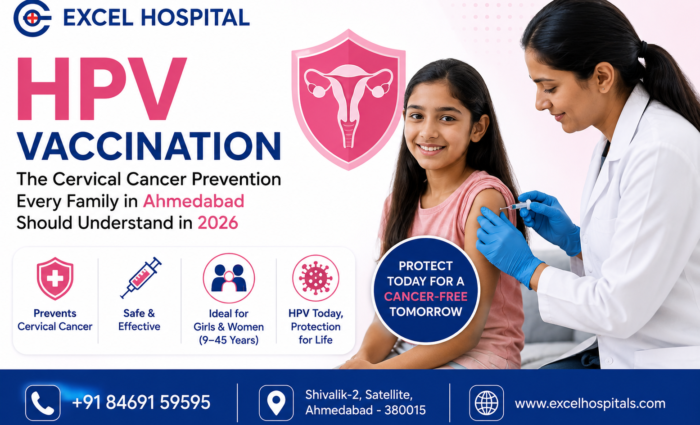

HPV Vaccination – The Cervical Cancer Prevention Every Family in Ahmedabad Should Understand in 2026
What Is HPV and How Does It Cause Cervical Cancer?
Human Papillomavirus, commonly known as HPV, is an extremely common virus transmitted primarily through skin-to-skin and sexual contact. It is so widespread that the vast majority of sexually active people will be exposed to at least one strain of HPV at some point in their lives. In most cases, the body’s immune system clears the infection naturally within one to two years, without causing any lasting harm.
The concern arises with certain high-risk strains of HPV that persist in the body instead of clearing. Over a period of ten to fifteen years, this persistent infection can gradually cause normal cervical cells to become abnormal, and eventually cancerous, if left undetected and untreated. According to the World Health Organization (WHO), HPV types 16 and 18 alone are responsible for approximately 70 percent of all cervical cancer cases worldwide, making them the primary targets of vaccination efforts globally.
This long window between infection and cancer development is precisely what makes cervical cancer so preventable. Vaccination before exposure prevents the persistent infection from ever taking hold, while regular screening after the age of appropriate onset catches any abnormal changes early, long before they progress to cancer.
How the HPV Vaccine Works and What It Prevents
The HPV vaccine works by training the immune system to recognise and neutralise specific HPV strains before the body is ever naturally exposed to them. It contains no live virus and cannot cause an HPV infection. Instead, it uses virus-like particles that closely resemble the outer shell of the HPV virus, prompting the immune system to build strong, lasting antibodies against it.
Because the vaccine works by preventing infection before it happens, it is most effective when given before a person becomes sexually active and is first exposed to HPV. This is the central reason vaccination is recommended at a relatively young age, well before any potential exposure occurs.
Beyond cervical cancer, HPV vaccination also protects against several other cancers and conditions linked to persistent HPV infection, including vulvar, vaginal, anal, and some throat and mouth cancers, as well as genital warts. This broader protection is one reason vaccination is now recommended for boys as well as girls in updated global guidelines.
Who Should Get Vaccinated, and at What Age?
The ideal age for HPV vaccination is before the onset of sexual activity, when the immune response to the vaccine is also strongest. However, vaccination still provides meaningful protection well beyond this ideal window, and many adults benefit from it even later in life.
| Age Group | Recommendation | Dosing Schedule |
|---|---|---|
| 9 to 14 years | Ideal window — strongest immune response, given well before likely exposure | Two doses, six months apart |
| 15 to 26 years | Still strongly recommended if not previously vaccinated | Three doses over six months |
| 27 to 45 years | Can still provide benefit through shared clinical decision-making with your doctor, particularly if exposure to all HPV strains is unlikely to have occurred yet | Three doses over six months |
| Already sexually active | Vaccination is still recommended — it protects against strains not yet encountered, even if some exposure has already occurred | As per age-appropriate schedule |
A common misconception is that vaccination is pointless once someone is sexually active, since HPV exposure may have already occurred. This is inaccurate. There are multiple high-risk HPV strains, and prior exposure to one does not mean exposure to all of them. The vaccine continues to offer meaningful protection against the strains not yet encountered.
HPV Vaccines Available in India
India has both an internationally established vaccine and an indigenously developed one, both of which are approved and available for use.
| Vaccine | Coverage | Notes |
|---|---|---|
| Quadrivalent / 9-valent HPV vaccine (Gardasil, Gardasil 9) | Protects against HPV types 6, 11, 16, 18, and additional high-risk strains in the 9-valent version | Internationally established, widely used with an extensive safety record spanning over a decade |
| Cervavac (Quadrivalent HPV Vaccine, India) | Protects against HPV types 6, 11, 16, and 18 | Indigenously developed and manufactured in India, offering a more accessible price point |
Both vaccines are considered effective and safe options for cervical cancer prevention. The choice between them is typically based on availability and individual clinical discussion with your gynaecologist, rather than one being clearly superior to the other for most patients.
HPV Vaccination in Ahmedabad — Excel Hospital
At Excel Hospital, Satellite, Ahmedabad, Dr. Aarti Vazirani provides HPV vaccination counselling and administration for both adolescents and adults, along with guidance on the appropriate vaccine and dosing schedule based on age and individual history. Families from across Ahmedabad, including Bopal, Bodakdev, Prahlad Nagar, Thaltej, and the SG Highway corridor, visit Excel Hospital for cervical cancer prevention services and screening.
Why HPV Vaccination Matters for Boys Too
HPV vaccination is often thought of as a vaccine only for girls, given its strong association with cervical cancer prevention. This is an outdated view. Updated global guidelines, including those from the WHO, recommend HPV vaccination for boys as well, for several important reasons.
- Direct protection for boys — HPV can cause genital warts, and penile, anal, and throat cancers in men, all of which the vaccine helps prevent
- Reduced transmission — vaccinated boys are significantly less likely to carry and transmit HPV to future partners
- Community-level protection — broader vaccination coverage across both sexes accelerates progress toward eliminating HPV-related cancers at a population level
- Equity in prevention — placing the full responsibility for HPV prevention on girls and women alone is both medically incomplete and increasingly viewed as an outdated approach
Several countries have already moved to gender-neutral HPV vaccination programmes, and awareness of this is gradually increasing in India as well. Parents in Ahmedabad considering vaccination for their children are encouraged to discuss options for both sons and daughters with their doctor.
Safety and Side Effects of the HPV Vaccine
The HPV vaccine has an extensive safety record, with hundreds of millions of doses administered globally since its introduction and continuous safety monitoring by health authorities worldwide. Like all vaccines, it can cause mild, temporary side effects, but serious adverse events are rare.
Soreness, redness, or mild swelling at the injection site is the most frequently reported reaction, typically resolving within a day or two without any specific treatment needed.
A small proportion of people experience mild headache, low-grade fever, or fatigue in the day following vaccination, similar to reactions seen with many other routine vaccines.
Brief fainting episodes can occur around the time of injection, particularly in adolescents, which is why observation for around fifteen minutes after vaccination is a standard precaution at most clinics.
Serious reactions are rare and have been extensively studied across large population datasets. Major global health bodies, including the WHO, continue to affirm the vaccine’s strong overall safety profile based on ongoing monitoring.
Vaccination Does Not Replace Screening
One of the most important messages in cervical cancer prevention is that HPV vaccination and cervical screening work together, and neither replaces the other. The vaccine significantly reduces the risk of infection with the most dangerous HPV strains, but it does not cover every single HPV type capable of causing cervical cancer, and it offers no benefit against infections that occurred before vaccination.
Regular cervical screening, through Pap smears or HPV DNA testing depending on age, remains essential for all women from the recommended screening age onward, regardless of vaccination status. This combination of prevention through vaccination and early detection through screening is what allows cervical cancer to be almost entirely preventable when both are followed consistently.
Related Services at Excel Hospital, Satellite, Ahmedabad
Common Myths About the HPV Vaccine — Cleared Up for Families in Ahmedabad
| Myth | Fact |
|---|---|
| The HPV vaccine is only necessary for girls | HPV vaccination is now recommended for boys as well, protecting them directly and reducing transmission to future partners |
| Vaccinating a child encourages early sexual activity | Multiple large studies have found no link between HPV vaccination and earlier onset of sexual activity among adolescents |
| Once you are an adult, the vaccine is no longer useful | Vaccination up to age 45 can still offer meaningful protection, particularly against HPV strains not yet encountered, based on individual discussion with a doctor |
| If I have already been vaccinated, I don’t need cervical screening | Vaccination does not cover every HPV strain, so regular screening remains essential for all women regardless of vaccination status |
| The vaccine can give you an HPV infection | The vaccine contains no live virus and cannot cause an HPV infection. It uses virus-like particles to train the immune system safely |
| HPV vaccines are new and not well studied | HPV vaccines have been in global use for close to two decades, with hundreds of millions of doses administered and continuous safety monitoring |
When to Talk to a Gynaecologist in Ahmedabad About HPV Vaccination
| Your Situation | What to Do |
|---|---|
| You have a child between 9 and 14 years old | Book a vaccination consultation — this is the ideal window for protection |
| You are a woman between 15 and 26 and have not been vaccinated | Schedule a consultation to begin the vaccination series |
| You are between 27 and 45 and considering vaccination | Discuss individual risk and potential benefit with your gynaecologist |
| You are already sexually active and unsure if vaccination still helps | Speak with a specialist — vaccination can still offer meaningful protection |
| You have never had a Pap smear or HPV screening | Book a cervical screening appointment alongside your vaccination discussion |
| You have a son and are unsure if vaccination applies to him | Discuss gender-neutral vaccination recommendations with your doctor |
Dr. Aarti Vazirani provides clear, evidence-based guidance on HPV vaccination and cervical cancer prevention for both adolescents and adults across Ahmedabad. She works closely with families to explain age-appropriate vaccination schedules, address common concerns, and ensure that vaccination and regular screening work together as a complete prevention strategy. Patients from Satellite, Bopal, Bodakdev, Thaltej, and across Ahmedabad trust her clear, honest approach to preventive women’s health. Learn more about Dr. Aarti Vazirani
Cervical Cancer Is Preventable — Take the First Step Today
Whether for your child, yourself, or your family, HPV vaccination is one of the most effective preventive health decisions available. Book a consultation at Excel Hospital, Satellite, Ahmedabad to discuss the right vaccination plan for your family.
Book Your Consultation in AhmedabadFrequently Asked Questions About HPV Vaccination in Ahmedabad
Medical Disclaimer: This article is written for general health awareness purposes only and does not constitute medical advice, diagnosis, or treatment recommendation. For personal health decisions related to HPV vaccination, please consult a qualified gynaecologist or physician. Information accurate as of 2026. Copyright 2026 Excel Hospital, Ahmedabad. All Rights Reserved. www.excelhospitals.com