


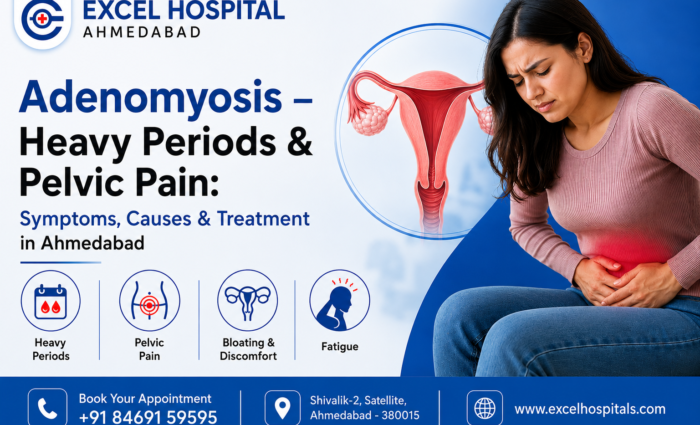

Adenomyosis – Heavy Periods, Pelvic Pain & What Women in Ahmedabad Need to Know in 2026

Severe period pain and heavy bleeding that disrupt daily life are hallmark signs of adenomyosis — a condition affecting 1 in 5 women that often goes undiagnosed for years
What Is Adenomyosis — And Why Is 2026 the Year to Know About It?
Adenomyosis is a gynaecological condition where the tissue that normally lines the inside of the uterus (the endometrium) grows into and through the muscular wall of the uterus (the myometrium). Every month during the menstrual cycle, this misplaced tissue swells, breaks down, and bleeds — but because it is trapped inside the uterine muscle, it cannot exit the body. The result is a progressively enlarged, bulky uterus, severe cramping, and extremely heavy periods.
Unlike endometriosis — where tissue grows outside the uterus — adenomyosis stays within the uterine wall. The two conditions can, and frequently do, occur together, which is why adenomyosis is so often misdiagnosed or missed entirely. Adenomyosis affects an estimated 20% of women, making it one of the most common gynaecological conditions in women of reproductive age — yet it receives a fraction of the clinical attention it deserves.
April 2026 is Adenomyosis Awareness Month — a globally recognised campaign dedicated to breaking the silence around this condition and improving diagnosis and treatment. For women in Ahmedabad, this is the year to stop normalising severe period pain and start getting answers.
In adenomyosis, endometrial tissue grows into the uterine muscle wall — causing the uterus to become enlarged and bulky, resulting in severe pain and heavy bleeding each month
Symptoms of Adenomyosis You Should Never Ignore
The challenge with adenomyosis is that its symptoms overlap significantly with other conditions — fibroids, endometriosis, PCOS — making self-diagnosis impossible and clinical evaluation essential. Here are the key warning signs:

Soaking through multiple pads within hours, passing large clots, or needing double protection. This level of blood loss causes iron-deficiency anaemia in many women — presenting as fatigue, breathlessness, and dizziness.
Cramping so intense it forces women to miss work, school, or social commitments — and which does not respond well to standard over-the-counter painkillers. Pain that worsens progressively year-on-year is a significant red flag.
A persistent dull ache or pressure in the lower abdomen throughout the month — not just during periods. Adenomyosis causes ongoing low-grade inflammation that doesn’t switch off between cycles.
Deep pelvic pain during or after sexual intercourse — caused by the enlarged, tender uterus and surrounding inflammation. Frequently under-reported due to embarrassment or lack of awareness that it signals a medical condition.
A uterus enlarged to 2–3 times its normal size — sometimes causing visible lower abdominal bloating or a feeling of pelvic heaviness. Your gynaecologist can detect an enlarged uterus on examination.
Periods that last significantly longer than normal — often starting with heavy days followed by prolonged spotting. This pattern of prolonged, heavy bleeding is one of the most characteristic features of adenomyosis.
Persistent exhaustion caused by a combination of chronic blood loss, anaemia, disrupted sleep from pain, and the systemic inflammatory load of adenomyosis — often dismissed as lifestyle-related stress.
Adenomyosis affects implantation by altering the uterine lining and creating an inflammatory environment hostile to embryo development. It is increasingly recognised as a significant — and often missed — cause of infertility and recurrent miscarriage.
Adenomyosis vs Endometriosis — Understanding the Difference
Adenomyosis and endometriosis are often spoken of together, yet they are distinct gynaecological conditions with different patterns, symptoms, and implications for a woman’s health and fertility. Understanding the difference helps ensure you receive the correct diagnosis and treatment.
| Feature | Adenomyosis | Endometriosis |
|---|---|---|
| Where tissue grows | Inside the uterine muscle wall | Outside the uterus — ovaries, tubes, peritoneum |
| Primary symptom | Very heavy periods + severe cramps | Severe pain — pelvic, ovarian, with sex |
| Uterus size | Enlarged (bulky, boggy) | Usually normal size |
| Who it affects most | Women 35–50, often after pregnancy | Women 20–40, often before first pregnancy |
| Diagnosed by | Ultrasound (TVS) or MRI | Laparoscopy (definitive) |
| Can they coexist? | Yes — up to 30% of women have both simultaneously | |
| Impact on fertility | Implantation failure, recurrent miscarriage | Tubal blockage, ovarian damage, poor egg quality |
What Causes Adenomyosis? Risk Factors Women Should Know
The precise cause of adenomyosis is not fully understood — but several contributing factors are well-established. Knowing your risk profile helps you seek evaluation sooner:
Previous C-sections, D&C procedures, myomectomy, or any uterine surgery can disrupt the boundary between the endometrium and myometrium — allowing endometrial cells to invade the muscle wall. This is one of the strongest risk factors in Indian women, given high C-section rates.
Adenomyosis is oestrogen-dependent — it develops and thrives under oestrogen stimulation. Conditions that elevate oestrogen (obesity, PCOS, early puberty, late menopause) all increase the risk. It typically improves significantly after menopause.
Family history of adenomyosis significantly increases personal risk. If your mother or sisters had severe period pain or a “bulky uterus,” your risk is elevated. Specific genetic variants affecting uterine muscle cell behaviour are being actively studied.
Chronic inflammation of the endometrium — from infection, immune dysfunction, or repeated trauma — may break down the natural barrier between the endometrium and myometrium, allowing tissue invasion over time.
Women who have had multiple pregnancies — particularly those with close spacing or complicated deliveries — have a higher rate of adenomyosis. Uterine stretching and repeated hormonal changes during pregnancies may contribute.
Adenomyosis is most common in women aged 35–50. However, recent evidence shows it is being increasingly identified in younger women — particularly those with a history of endometriosis or early menstrual dysfunction — which means the “only affects older women” assumption is outdated.
How Is Adenomyosis Diagnosed in Ahmedabad?
Historically, adenomyosis could only be definitively confirmed after a hysterectomy by examining the removed uterus under a microscope. That changed with advances in imaging. Experts now confirm that adenomyosis can be diagnosed on ultrasound scans — something that was previously widely doubted. This is a major clinical advance that allows non-surgical diagnosis and earlier intervention.


| Investigation | What It Shows | Accuracy for Adenomyosis |
|---|---|---|
| Transvaginal Ultrasound (TVS) | Uterine wall texture, asymmetry, subendometrial cysts, increased vascularity | High — 83–85% sensitivity in experienced hands |
| MRI Pelvis | Precise extent and depth of adenomyosis; focal vs diffuse; junction zone thickness | Highest accuracy — gold standard for pre-surgical planning |
| Blood Tests (FBC, Ferritin) | Anaemia assessment from chronic blood loss | Essential in all women with heavy bleeding |
| Hysteroscopy | Direct view of uterine cavity; rules out polyps, fibroids as contributing causes | Cannot directly confirm adenomyosis but aids differential diagnosis |
| Histology (after surgery) | Definitive microscopic confirmation | 100% — but requires hysterectomy specimen |
🏥 Adenomyosis Diagnosis in Ahmedabad — Excel Hospital
At Excel Hospital, Satellite, Ahmedabad, Dr. Aarti Vazirani provides comprehensive adenomyosis evaluation including transvaginal ultrasound, hormonal blood work, MRI referral for surgical planning, and personalised treatment counselling — all under one roof. Women from across Ahmedabad — including Bopal, Prahlad Nagar, Bodakdev, Thaltej, and SG Highway areas — visit Excel Hospital for specialist women’s care.
Adenomyosis Treatment Options in Ahmedabad — From Medication to Surgery
Adenomyosis treatment is not one-size-fits-all. The right approach depends entirely on your symptom severity, whether fertility is a priority, and how close you are to menopause. Here’s a clear breakdown of what’s available:
Medical (Hormonal) Management
Hormonal therapies suppress oestrogen and reduce adenomyosis activity — providing significant symptom relief for many women. Options include:
| Medication | How It Helps | Suitable For |
|---|---|---|
| Mirena IUS (Hormonal Coil) | Local progesterone reduces bleeding by 80–90%; reduces pain over 3–6 months | Best first medical option for most women |
| Combined OCP (Pill) | Regulates cycle, reduces bleeding and cramping | Women who also want contraception |
| GnRH Agonists | Creates temporary menopause; shrinks adenomyosis tissue significantly | Pre-surgical shrinkage; bridging to menopause |
| Dienogest (Progestogen) | Suppresses adenomyosis growth; improving pain outcomes | Growing evidence base; good long-term option |
| Tranexamic Acid | Reduces menstrual blood loss volume | Used alongside hormonal therapy for heavy bleeding |
Surgical Options — For Severe or Fertility-Impacting Cases
When medication is insufficient or when fertility is the priority, surgery offers more targeted solutions. At Excel Hospital’s Minimally Invasive Gynaecological Surgery Clinic in Ahmedabad, the following procedures are available:
Laparoscopic Adenomyomectomy — Surgical removal of focal adenomyosis deposits while preserving the uterus. Suitable for women with focal (localised) adenomyosis who wish to preserve fertility. More technically demanding than fibroid myomectomy but achievable in specialist hands.
Hysterectomy — The definitive cure for adenomyosis. Recommended only for women who have completed their family and have severe, treatment-resistant symptoms. Laparoscopic hysterectomy (keyhole removal) has a faster recovery than open surgery — typically 1–2 days in hospital and return to normal activity within 2–3 weeks.
Endometrial Ablation — Destruction of the uterine lining using heat or radiofrequency energy. Effective for reducing bleeding in some women, but not suitable for those planning pregnancy and less effective in diffuse adenomyosis.
Adenomyosis and Fertility — What Women in Ahmedabad Need to Know
One of the most important — and least discussed — aspects of adenomyosis is its impact on fertility. Adenomyosis affects the ability to conceive and carry a pregnancy through several mechanisms:
- Altered uterine contractility — affects sperm transport and embryo movement
- Impaired endometrial receptivity — the uterine lining does not accept embryos as effectively
- Inflammatory environment — increases risk of early miscarriage
- Structural changes — disrupts normal implantation of the embryo
For women with adenomyosis who are trying to conceive at Excel Hospital’s Infertility Clinic in Ahmedabad, the approach includes a thorough pre-conception evaluation, hormonal suppression to improve uterine environment, and where needed, laparoscopic surgery before IVF — which has been shown to significantly improve embryo transfer outcomes.
🔗 Related Services at Excel Hospital, Ahmedabad
Common Adenomyosis Myths — Cleared Up for Women in Ahmedabad
| ❌ Myth | ✅ Fact (2026) |
|---|---|
| Painful, heavy periods are just part of being a woman | Severe, disabling period pain and flooding are not normal — they are symptoms of diagnosable, treatable conditions like adenomyosis |
| Adenomyosis can only be diagnosed after a hysterectomy | Since 2024–2026, high-resolution transvaginal ultrasound and MRI can diagnose adenomyosis non-surgically with high accuracy |
| Hysterectomy is the only treatment | Medical management, hormonal IUS, and laparoscopic adenomyomectomy offer effective fertility-preserving alternatives for most women |
| Adenomyosis only affects older women after children | Adenomyosis is increasingly diagnosed in younger women in their 20s and 30s, and can affect women who have never been pregnant |
| You cannot get pregnant with adenomyosis | Many women with adenomyosis conceive — naturally or with fertility treatment. Pre-conception specialist evaluation is the key |
| Adenomyosis goes away after childbirth | Adenomyosis may temporarily improve during pregnancy due to hormonal changes, but it returns. Childbirth is not a treatment |
When to See a Gynaecologist in Ahmedabad for Adenomyosis
| Your Situation | What to Do |
|---|---|
| Period pain so severe you miss work or need strong medication | 🟠 Book a gynaecology consultation — this is not normal |
| Flooding, passing large clots, or periods lasting 7+ days | 🟠 Get pelvic ultrasound + blood tests done this week |
| Constant fatigue, breathlessness — possible anaemia from heavy bleeding | 🟠 See a gynaecologist — iron tablets alone are not the answer |
| Trying to conceive with no success after 6–12 months | 🟠 Request adenomyosis evaluation as part of fertility workup |
| Pelvic heaviness or abdominal bloating throughout the month | 🟡 Pelvic ultrasound to rule out enlarged uterus from adenomyosis |
| Painful intercourse you haven’t discussed with a doctor | 🟡 This is treatable — a gynaecologist in Ahmedabad can help |
Dr. Aarti Vazirani is one of Ahmedabad’s trusted women’s health specialists, with extensive experience in diagnosing and managing adenomyosis, endometriosis, fibroids, and other complex gynaecological conditions. She uses a personalised, evidence-based approach — prioritising fertility preservation and minimally invasive treatment wherever possible. Women from across Ahmedabad — Satellite, Bopal, Bodakdev, Prahlad Nagar, SG Road — trust her for clear answers and compassionate care. Learn more about Dr. Aarti Vazirani →
Suffering Through Heavy Periods Is Not Your Only Option
If you have been told your painful, heavy periods are “just normal” — get a second opinion at Excel Hospital, Satellite, Ahmedabad. Adenomyosis is diagnosable and treatable. Book your consultation today.
📅 Book Your Consultation in AhmedabadFrequently Asked Questions About Adenomyosis in Ahmedabad
Medical Disclaimer: This article is written for general health awareness purposes only and does not constitute medical advice, diagnosis, or treatment recommendation. For personal health concerns related to adenomyosis, please consult a qualified gynaecologist. Information is accurate as of April 2026. | © 2026 Excel Hospital, Ahmedabad. All Rights Reserved. | www.excelhospitals.com